 Uwulend
 looping: borrowing to redeposit
UwU Lend’s 2024 guides describe same-asset looping on Ethereum as repeated borrowing and redepositing. Each round enlarges supplied balances and debt, changing the amounts on which interest and any allocated UwU rewards accrue. Opening or increasing a loop depends on the selected reserve accepting deposits and borrowing while the lending pool isn’t paused.
· updated
How redeposits change the position
Borrowing creates a liability in the borrowed asset. Supplying that asset again adds to the supplied balance represented by uTokens and can increase borrowing capacity when the deposit is eligible and enabled as collateral. Repetition expands gross supply and gross debt together. The larger supplied balance therefore includes borrowed capital; it isn’t all capital owned free of debt.
UwU Lend’s Part Five: Looping and Vaults, published April 7, 2024, described token approval and delegation approval before the loop transaction. That transaction bundled repeated borrowing and supplying. A higher loop count required more actions and increased gas costs; the approvals alone didn’t execute the loop.
Rate bases and borrowing limits
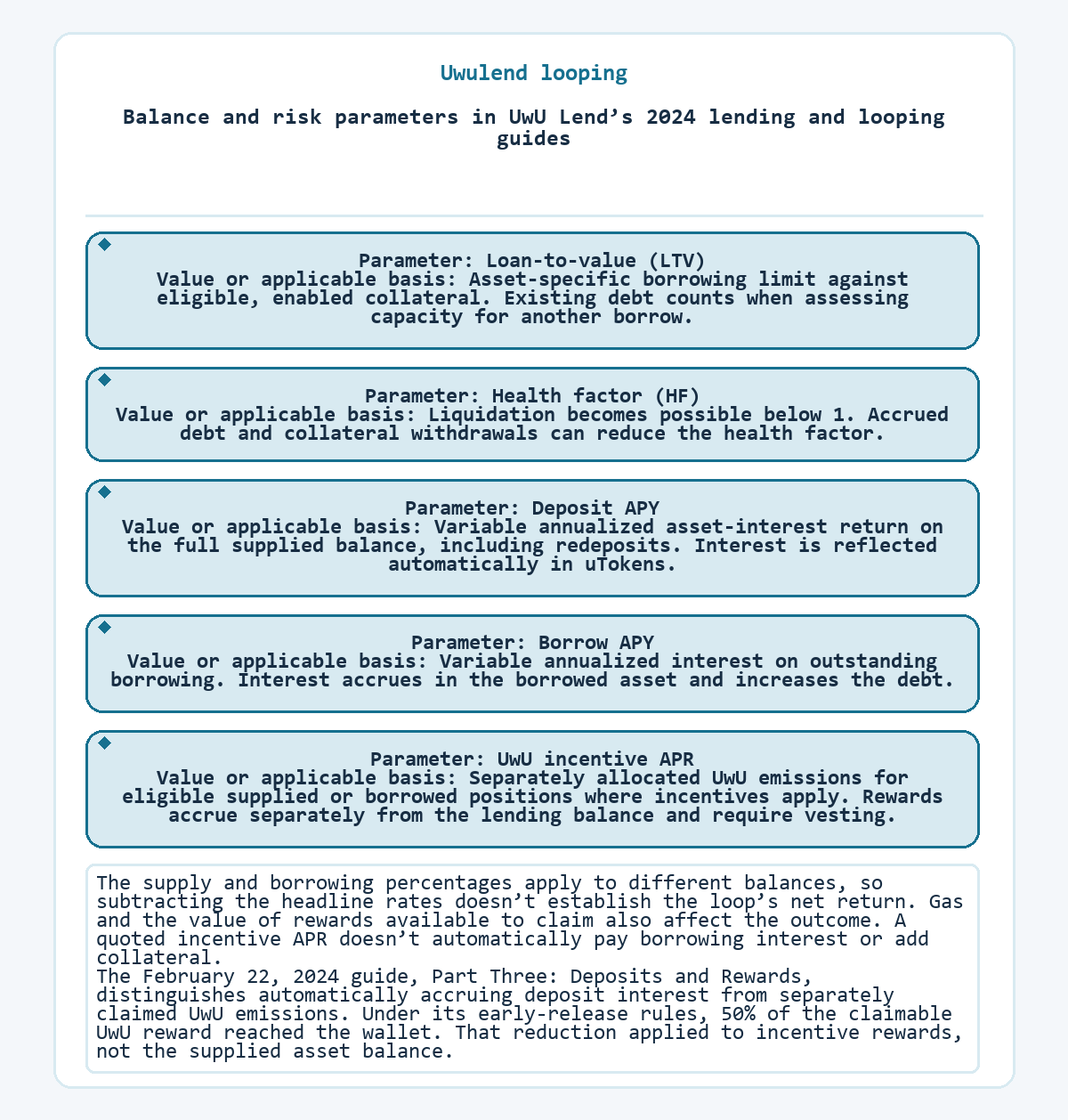
| Parameter | Value or applicable basis |
|---|---|
| Loan-to-value (LTV) | Asset-specific borrowing limit against eligible, enabled collateral. Existing debt counts when assessing capacity for another borrow. |
| Health factor (HF) | Liquidation becomes possible below 1. Accrued debt and collateral withdrawals can reduce the health factor. |
| Deposit APY | Variable annualized asset-interest return on the full supplied balance, including redeposits. Interest is reflected automatically in uTokens. |
| Borrow APY | Variable annualized interest on outstanding borrowing. Interest accrues in the borrowed asset and increases the debt. |
| UwU incentive APR | Separately allocated UwU emissions for eligible supplied or borrowed positions where incentives apply. Rewards accrue separately from the lending balance and require vesting. |
The supply and borrowing percentages apply to different balances, so subtracting the headline rates doesn’t establish the loop’s net return. Gas and the value of rewards available to claim also affect the outcome. A quoted incentive APR doesn’t automatically pay borrowing interest or add collateral.
The February 22, 2024 guide, Part Three: Deposits and Rewards , distinguishes automatically accruing deposit interest from separately claimed UwU emissions. Under its early-release rules, 50% of the claimable UwU reward reached the wallet. That reduction applied to incentive rewards, not the supplied asset balance.
Same-asset pricing and liquidation
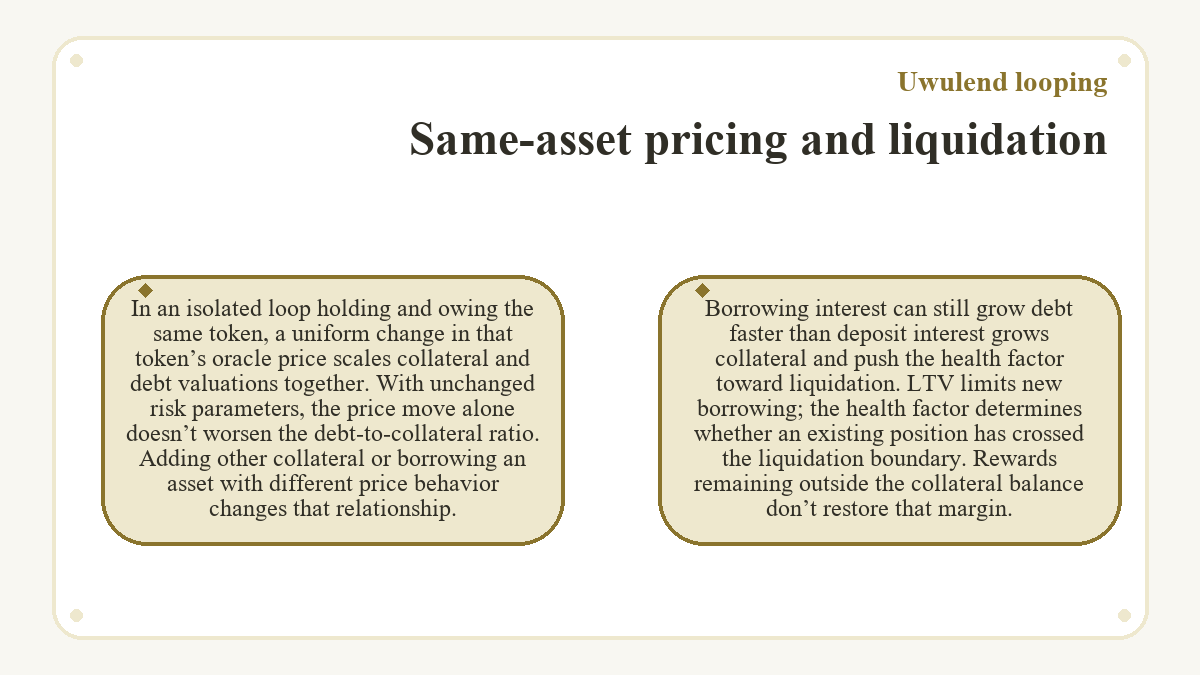
In an isolated loop holding and owing the same token, a uniform change in that token’s oracle price scales collateral and debt valuations together. With unchanged risk parameters, the price move alone doesn’t worsen the debt-to-collateral ratio. Adding other collateral or borrowing an asset with different price behavior changes that relationship.
Borrowing interest can still grow debt faster than deposit interest grows collateral and push the health factor toward liquidation. LTV limits new borrowing; the health factor determines whether an existing position has crossed the liquidation boundary. Rewards remaining outside the collateral balance don’t restore that margin.
Yield-bearing collateral adds a separate relationship
The April 2024 looping guide also discusses auto-compounding collateral such as sDAI. Yield generated inside the underlying vault is separate from UwU Lend’s supply interest and UwU incentives. When the same vault token is supplied and borrowed, repayment remains denominated in that token plus borrowing interest. Growth in its underlying value affects the valuation of the liability as well as the supplied holdings.
Unwinding depends on the remaining debt
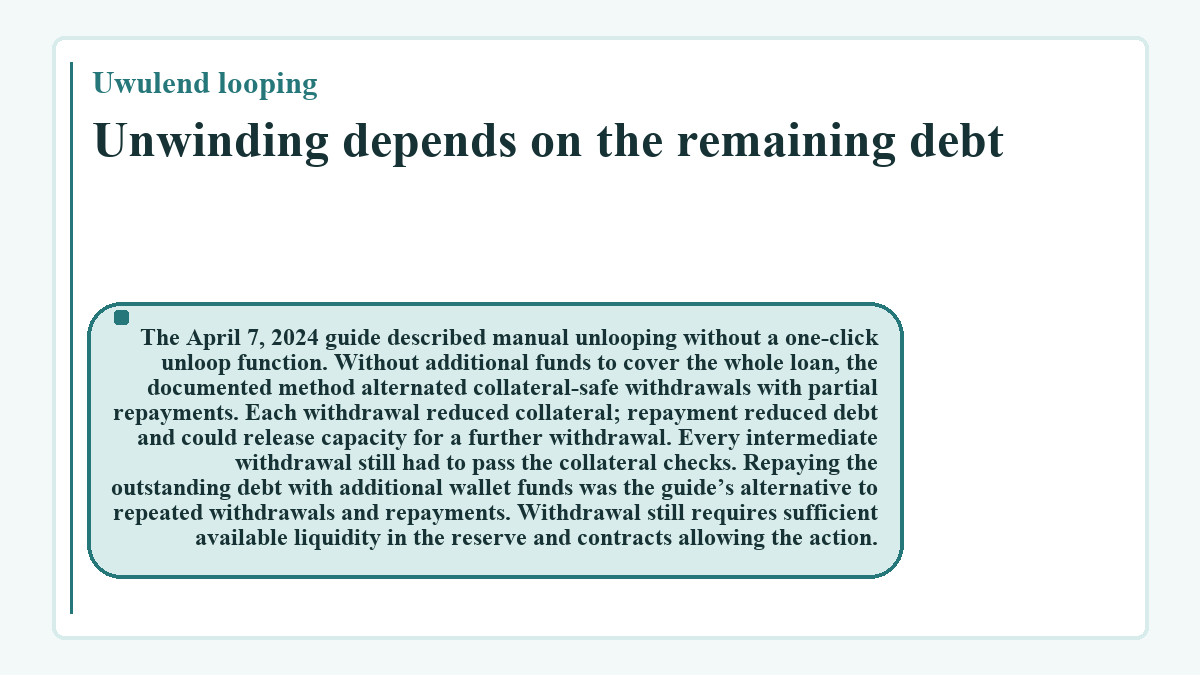
The April 7, 2024 guide described manual unlooping without a one-click unloop function. Without additional funds to cover the whole loan, the documented method alternated collateral-safe withdrawals with partial repayments. Each withdrawal reduced collateral; repayment reduced debt and could release capacity for a further withdrawal. Every intermediate withdrawal still had to pass the collateral checks.
Repaying the outstanding debt with additional wallet funds was the guide’s alternative to repeated withdrawals and repayments. Withdrawal still requires sufficient available liquidity in the reserve and contracts allowing the action.
Reserve restrictions and protocol failures
In the published Aave V2-derived lending contracts, a reserve freeze blocks new deposits and borrowing. Withdrawal and repayment aren’t blocked by the freeze flag alone, while a pool-wide pause blocks all four actions. These rules describe that contract version; actual access depends on the deployed contracts and their settings.
DefiLlama has flagged the uUSDT market as frozen for new deposits . That market-specific warning means the 2024 instructions can’t be assumed usable for a new position there. A displayed yield doesn’t establish that the reserve accepts the actions a loop requires.
BlockSec’s Monthly Security Review: June 2024 , published July 1, 2024, identifies oracle-price manipulation in the June 10 attack and inconsistent LTV and health-factor treatment of uSUSDe in the June 13 attack. It reports combined losses exceeding $23 million. Matching the deposit and debt asset doesn’t protect a position from either type of protocol failure.